
Miami County Court Record Requests
The Miami County Clerk of Courts keeps the filings and records. It serves Circuit, Superior I, and Superior II. You will find the office in Room 208 at 25 N Broadway, Peru, Indiana 46970. Doors are open Monday through Friday, 8:00 a.m. to 4:00 p.m. Call 765-472-3901 or fax 765-472-1778. Deputies can point you to the right court and explain public process. They cannot give legal advice.
Each lookup route has its own job. MyCase offers nonconfidential case and CCS data online. Doxpop sits on top as an official-linked vendor layer. A courthouse terminal gives the public another way in, and the Clerk counter handles in-person questions and copies. Phone works well for confirming the right division and its current requirements. Mail or fax can succeed once staff confirms the format, destination, cost, and payment. The clerk offers no generic email, drop box, or universal certified-copy web form.
- Find the exact case number, filing court, and document or entry date.
- Review MyCase to identify the CCS event or public document.
- Call the Clerk when the item is missing, restricted, or needed in certified form.
- State ordinary or certified copy, paper or electronic delivery if available, and one document or the full public file.
- Confirm the current fee, payment method, turnaround, and delivery before mailing funds.
Miami County Court Record Desk
Official county sources name Sherry Raber as the current Miami County Clerk. General reception answers at 765-472-3901, extension 1255. Each division has its own extension: Circuit civil at 1256, Superior I civil at 1275, Superior II civil at 1270, Superior I and Circuit criminal/BMV work at 1239, Superior II criminal at 1254, and paternity, juvenile, and guardianship at 1253. The state directory lists slightly different extension conventions. The main line remains the sound fallback when a direct number misfires.
Miami County Clerk of Courts
25 N Broadway, Room 208
Peru, IN 46970
Monday-Friday, 8:00 a.m.-4:00 p.m.
765-472-3901
Ask staff to confirm the file, the access route, the copy type, and whether you need certification. A judge's office is not the copy counter. Transcripts belong to the court reporter, the prosecutor keeps its own files and diversion questions, the BMV holds driver records, and federal clerks handle federal matters.
Kinds of Court Records
Three products get confused all the time. The docket, or CCS, is a dated index of filings, hearings, orders, and outcomes. A filed document is the actual pleading, order, judgment, exhibit, or notice behind an entry. A certified copy adds Clerk authentication for official use. A transcript stands apart. It is the court reporter's written record of what was said in the proceeding.
- Chronological Case Summary and individual docket entries
- Pleadings, motions, notices, and service records that remain public
- Orders, rulings, judgments, and disposition records
- Public financial entries and payment records maintained in the case
- Certified copies prepared by the Clerk
- Transcripts ordered through the relevant court reporter
A browser printout or a Doxpop result is not certification. Online document access can vary with conversion, document type, retention, outages, and Indiana's access rules.
Miami County Court Record CCS
Indiana Trial Rule 77 makes the official record more than a result screen. The Chronological Case Summary is its sequential spine, recording filings, fees, notices, settings, orders, rulings, judgments, payments, and status changes as they happen. When you prepare a request, preserve the case number, the event date, the full entry description, the document title, and the access status.
- CCS
- The Chronological Case Summary, a dated sequence of judicial and case activity.
- Docket entry
- A dated note of a filing, hearing, order, payment, or administrative event.
- RJO
- A chronological record or order required in specified contexts by Trial Rule 77.
- Certified copy
- A Clerk-authenticated copy, not a portal printout.
- Transcript
- The court reporter's written record of spoken proceedings.
Sequence matters. An early motion does not state the final ruling, and a calendar setting does not prove the hearing occurred. Read forward in the CCS to the later order, judgment, cancellation, reset, or disposition.
Court Records: What They Contain
The fields in a public Miami County file vary. Case type and access status drive what appears. MyCase gives an orientation view, while the Clerk controls official copies. Criminal records may add charge and bond fields. Civil files may show service, motions, judgments, and proceedings supplemental. Not every listed event comes with a public downloadable document.
| Identity | Case style, number, filing court, and type. |
|---|---|
| Dates and status | Filed date, status, status date, and appear-by date when shown. |
| Parties | Public party names, role codes, and attorney associations. |
| CCS events | Dated descriptions of filings, hearings, orders, rulings, and payments. |
| Documents | Public links, names, and types when an image is available. |
| Financial fields | Balance and as-of date, subject to the Clerk's warning that other sums may be omitted. |
Use these fields to name one record precisely rather than asking staff to guess what "the whole docket" means.
Miami County Court Record E-Filing
Indiana's IEFS handles filing and service. MyCase handles public lookup. Trial Rule 87 requires electronic filing unless an exemption applies, starting August 1, 2026. A document can land in Odyssey yet never become a public PDF. Display still follows conversion and access rules. You do not need an IEFS account to read a public record that MyCase makes available.
The official Indiana e-filing workflow shows how filer identity, court, case, event, upload, service, fee, review, and confirmation fit together.
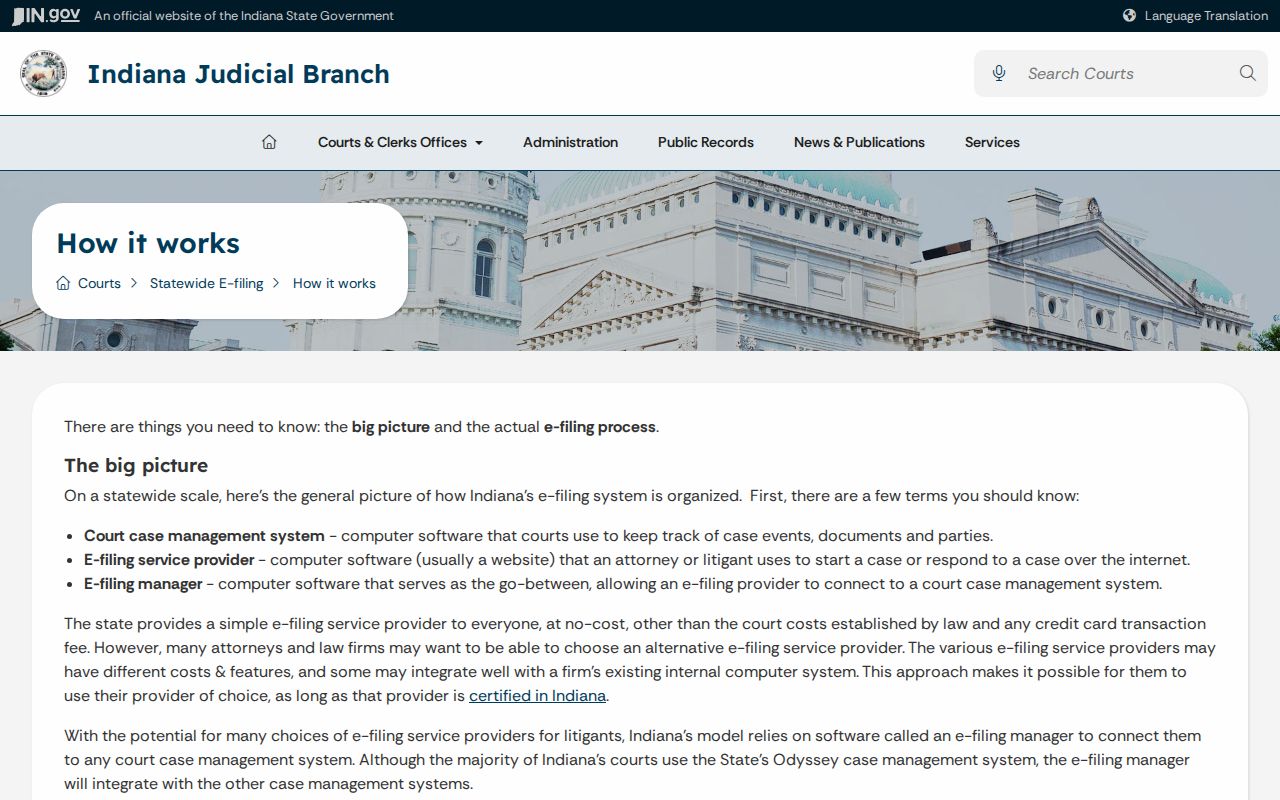
The workflow explains how a filing reaches the court record. It does not promise that the public can open the filed image online.
Copy Fees and Certification
Miami County's official court pages publish no universal Clerk copy price or processing time. Ask before you pay. Get the current ordinary-copy rate, the certification charge, accepted payment, delivery choice, and turnaround. Never mail money based on a fee from another county. For a transcript, check the Miami local rules. They carry a separate reporter schedule.
| Item | Published amount | What to confirm |
|---|---|---|
| Plain Clerk copy | Not located | Per-page price and delivery |
| Certified Clerk copy | Not located | Certification type and total |
| Private transcript | Maximum $6 per page | Reporter and current application |
| Indigent transcript | Maximum $5 per page | Eligibility and order |
| Expedited transcript | Additional $2.50 per page | Work within 14 days |
| Transcript minimum | $35 | Supply or labor charges |
Transcript rates are not Clerk copy rates. Certification, a seal, and a reporter's transcript are distinct products, so name each one precisely when you order.
Miami County Court Record Request Checklist
A tight, specific request gets better results than a vague one. Start with the court and the case number. From there, name the exact document you want, its CCS entry date, and the form you need it in. Older files take a little more detail. Add the approximate year, and ask the clerk whether a pre-Odyssey or archival search applies. Miami Circuit, Superior I, and Superior II moved onto Odyssey in December 2018, and files from before that date still exist even if not every one was converted.
- Case number and Miami County court
- Party or case style only as a cross-check
- Exact document, order, or CCS date
- Plain, certified, or transcript product
- Paper or electronic delivery if offered
- Return address and approved payment after confirmation
For anything serious, save the official source URL, the access date, and any staff confirmation you receive. The Miami County docket search can pin down the case number before you ask for copies.
Access Rules for Court Records
No rule makes everything public at once. Each record gets its own call. Indiana's Indiana Access to Public Records Act allows exceptions and sends requesters to the office holding the record. Case files answer to Indiana's court-specific Access Rules instead. Rule 5 can seal an entire case. It can also shield a single item inside an otherwise public file.
What falls outside public view? Confidential or sealed matters, mental-health cases covered by state law, investigative requests, certain older paternity matters, privileged material, protected supervision records, and anything restricted by statute or court order. Juvenile and protection-order information may be absent from the public portal. Keep two cautions in mind. A closed case is not automatically open, and seeing a case header does not entitle you to every document inside it.
Key access rules: Indiana Access Rules 1-12 set the court-record framework. Access Rule 5 identifies exclusions and redaction procedures. Trial Rule 77 defines official record components.
The official Rule 5 page illustrates excluded records and redaction.
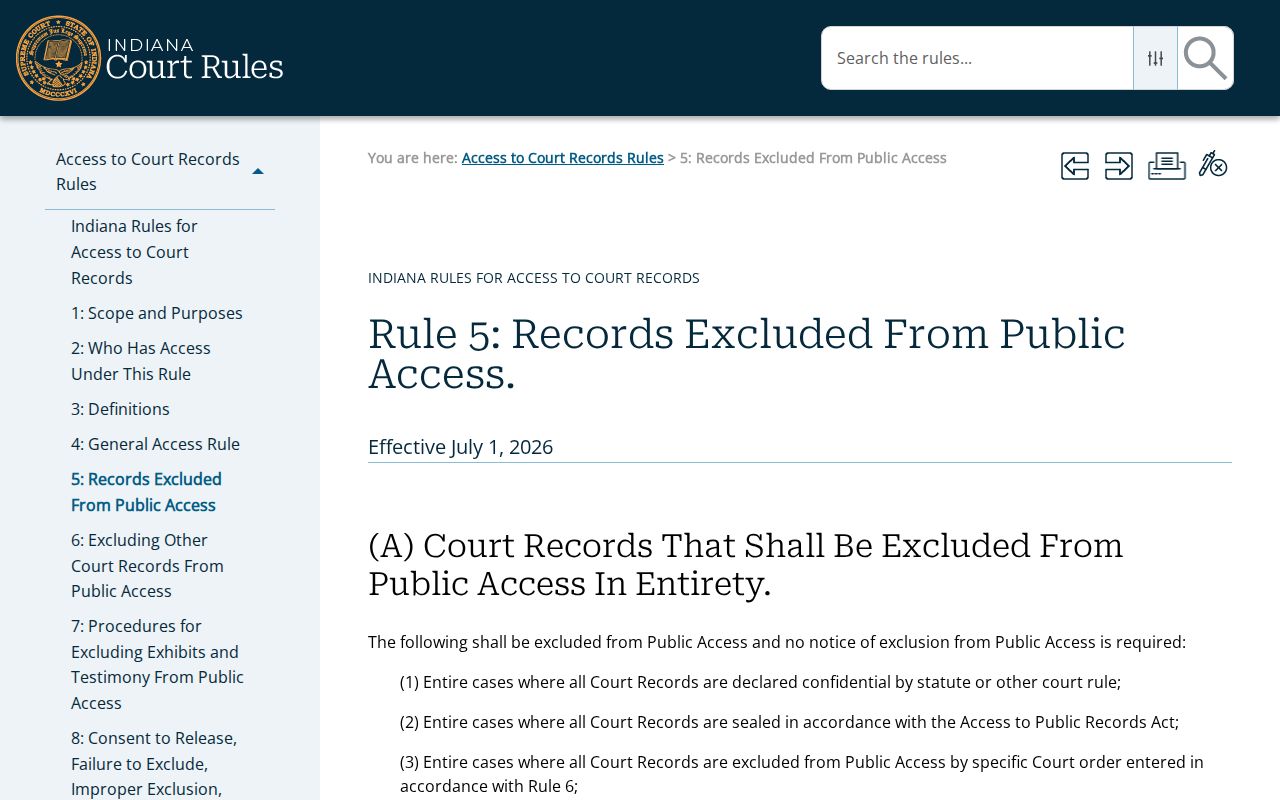
One filing can stay hidden while the rest of a Miami County case remains public. The rule explains why that happens.
Miami County Court Record Custodians
The Clerk of Court keeps the files for Miami Circuit and the Superior courts, but not every paper tied to the same event. Driver records sit with the Indiana Bureau of Motor Vehicles. The prosecutor keeps its own office files, and police agencies hold incident records. Transcripts come from the court reporter. Federal district cases belong to the Northern District of Indiana and PACER, while bankruptcy filings go through the Northern District bankruptcy system.
APRA does not shift any of those duties onto the Miami County Clerk. Ask which office created and maintains the record you want. A state docket may reference a suspension, a charge, a report, or a federal matter, yet that reference never turns the agency's file into a court record. Sending the request to the right office the first time saves accuracy and hours.
Older Miami County court records can require a different path. Circuit, Superior I, and Superior II joined Odyssey in December 2018, and that cutover did not destroy earlier paper or archived files. Give Room 208 an approximate filing year, the likely court, the party names, and any former case number. Staff can tell you whether the Miami County Clerk holds the item, whether an archive search is needed, and which copy procedure applies now. A failed MyCase search, by itself, settles none of that.