
Miami County Criminal Docket Searches
Indiana MyCase is the free public view of nonconfidential Odyssey cases. Its Case tab gives you three separate boxes: case number, citation number, and cross-reference. Match the identifier to the paper in hand and use only that one. Pick Miami County, and choose Criminal & Citation. Check the court, filed date, case type, parties, and status. Only then open the Chronological Case Summary, the CCS.
- Read the ticket, summons, or notice for the exact court and identifier.
- Try the exact case number first, or use Citation Number for a ticket.
- If no number is known, search the party name and narrow by Miami County and date.
- Open the matching result and read CCS events from oldest to newest.
- Confirm a hearing through Trial Court Calendars and ask the Clerk for an official copy.
Broad searches can hit a 1,000-result cap. MyCase may ask you to complete a captcha. When a search stalls, change one thing at a time. Try punctuation, the court category, the filing range, spelling, or a different identifier type. A transferred matter can be traced through search history. Sealed or excluded records will not surface in public results.
Miami Criminal Case Numbers Decoded
The statewide numbering pattern comes from Indiana Administrative Rule 8. Every Miami County case number encodes the county, the court, the filing year, the case type, and a sequence. So 52C01 means Circuit, while 52D01 and 52D02 point to Superior I and Superior II. Two cautions apply. The type code is not an outcome. The sequence says nothing about how serious a case is. For the full breakdown of components, the official case-numbering rule spells them out.
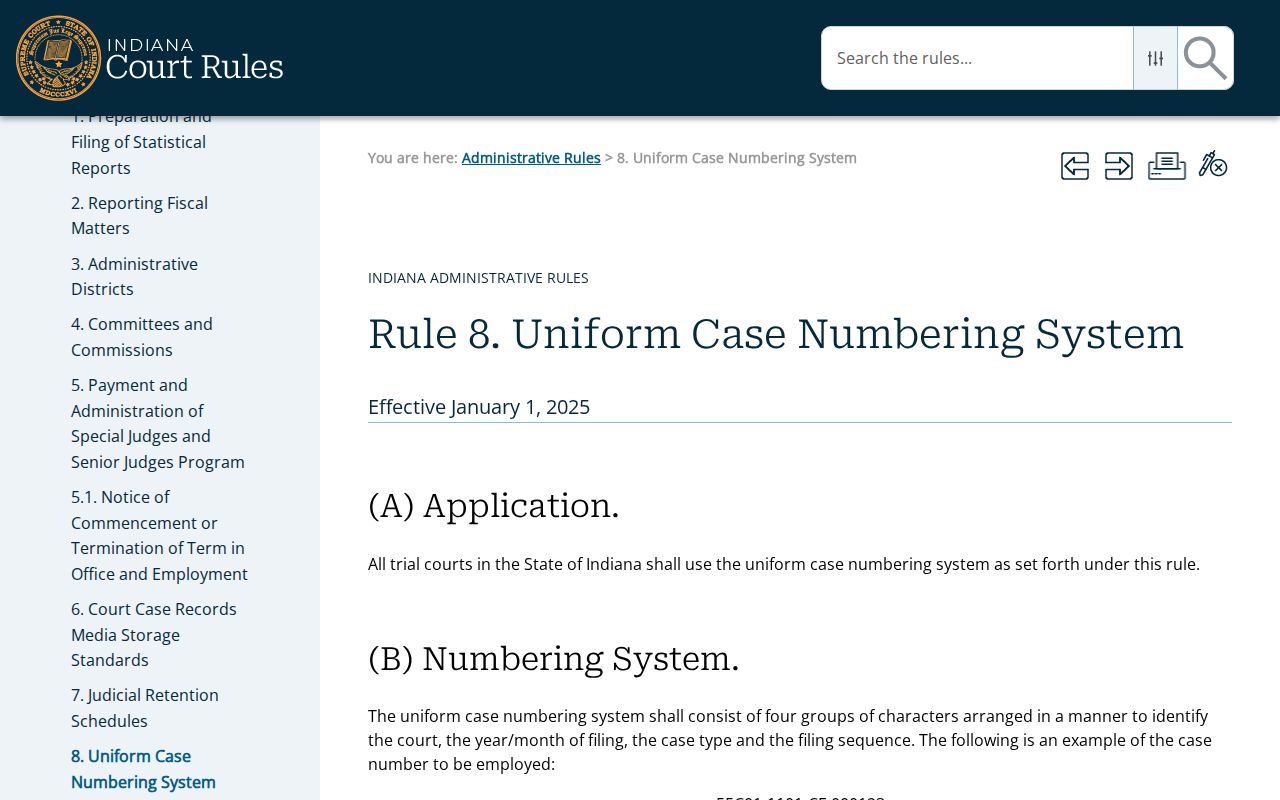
The rule lets a reader separate the court identifier from the case-type and sequence fields before calling the Miami County Clerk.
Criminal Dockets: What They Show
A public Miami County criminal docket opens with identifying fields. Events follow in date order. The first charge line is only an allegation, and it can change later. So treat nothing there as a final result. The docket may also display a balance. That figure is for orientation only, since interest or other clerk charges may not be included.
| Case header | Case number, court, type, filed date, status date, flags, appear-by date, references, and related cases. |
|---|---|
| Charge detail | Charge number, offense date, description, and any modification. |
| Bond | Posted date, bond type, amount, and linked details when public. |
| CCS events | Dated settings, filings, pleas, orders, cancellations, documents, and disposition entries. |
| Financial fields | Balance and as-of date when the public view supplies them. |
Miami Charges, Changes, and Outcomes
Charge, modification, plea, and disposition each get their own docket lines. One count can be amended or dismissed while another survives. A CCS entry might record a filing, a notice, a warrant event, a bond change, or a hearing. None of that establishes a conviction. Read the later orders and judgments. If exact wording matters, request the filed document itself.
- Charge
- The alleged offense identified in a count.
- Modification
- A later change to the offense description or count.
- Disposition
- The court's recorded resolution of a charge or case.
- CCS
- The Chronological Case Summary, Indiana's dated sequence of court events.
Open, closed, and disposed are status labels, not access labels. A closed case can still hold a restricted document. An open one might have no future hearing posted yet.
Criminal Case Stages on the Docket
No two Miami County criminal cases run on the same track. Most dockets, though, move from an initial filing and hearing through pretrial events toward a plea or trial and a disposition. In between, expect motions, bond reviews, continuances, warrants, and document filings. The docket is a chronology. It does not promise that every stage will occur.
Docket flow: Filing › Arraignment › Pretrial › Plea or Trial › Disposition › Sentencing
A calendar entry only reports a planned setting. It proves nothing about what happened. Confirm outcomes in the later CCS entry, order, or judgment, and ask the court reporter about a transcript, since MyCase will not contain one.
Miami Criminal Filings in Context
Indiana's certified 2024 ICOR activity chart counts new felony filings across all Miami County courts: 3 at Level 1, 13 at Level 2, 9 at Level 3, 23 at Level 4, 83 at Level 5, and 314 at Level 6. Misdemeanors came to 1,001, and the miscellaneous-criminal category listed 1,028 matters. These are case activity counts. They are not unique people, convictions, or a live caseload.
That volume is why exact identifiers and the assigned court matter so much. The figures say nothing about the result or content of any single Miami County criminal docket.
Miami County Criminal Docket Courts
Under current local allocation, murder and Level 1 through Level 4 felonies go to Miami Circuit Court. Superior Court II takes most nontraffic misdemeanors plus Level 5 and Level 6 felonies. Traffic, infraction, and ordinance work lands in Superior Court I. All three courts sit in the same building, the Miami County Courthouse at 25 N Broadway in Peru.
| Court | Current criminal assignment | Public route |
|---|---|---|
| Circuit, 52C01 | Murder and Level 1 through 4 felonies; Drug Court is identified here. | MyCase, calendar, Clerk Room 208 |
| Superior I, 52D01 | Traffic, infractions, and ordinance violations. | MyCase, calendar, traffic line |
| Superior II, 52D02 | Nontraffic misdemeanors and most Level 5 and 6 felonies. | MyCase, calendar, Clerk |
One change is already scheduled. A July 2026 order assigns specified Level 5, Level 6, and misdemeanor sex-offense matters to Circuit starting January 1, 2027. Until then, a current ticket, caption, or Clerk confirmation controls which court holds the case.
Miami Criminal Record Access Channels
Miami County gives you several ways to pull a criminal docket. MyCase shows the public case view, Trial Court Calendars shows settings, and Doxpop adds a vendor layer tied to official filings that is not the record itself. Prefer the counter for anything hands-on. The Clerk's Room 208 terminal works too. Call 765-472-3901 for the main Clerk line, extension 1239 for Circuit or Superior I, and extension 1254 for Superior II.
Phone before you mail or fax anything. The Clerk lists fax 765-472-1778 but no general email request form or flat copy-fee schedule. In your request, give the case number and name the exact document. Say whether you want an ordinary or certified copy. Ask for the current total plus how to pay. Transcripts go through the court reporter instead. Prosecutor files, diversion questions, and probation records all live outside the court CCS.
Federal charges are a different world. They sit in the Northern District of Indiana, South Bend Division, not MyCase. The official division page confirms that South Bend serves Miami County.
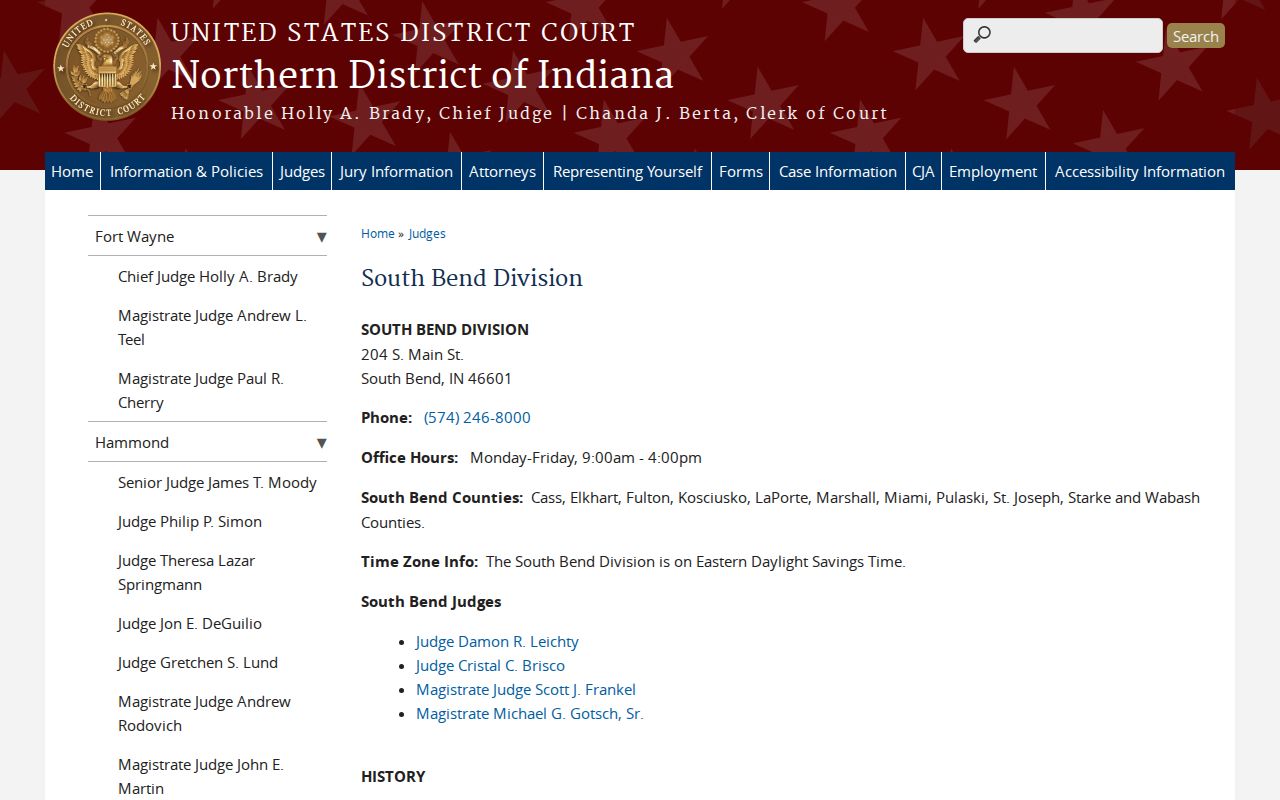
That division listing exists to point you to the right federal route. Without it, a state case number can easily land in the wrong system.
Miami State and Federal Formats
Format tells you which system you are in. A Miami County state number opens with an Indiana county and court code. A federal number is built differently. The Northern District strings together division, year, case type, sequence, and the judge's initials, in a pattern like 2:26-cv-00368. That docket lives in PACER or CM/ECF, not Indiana MyCase.
The federal CM/ECF court information page also explains status flags. A flag can mark a matter sealed, stayed, transferred, consolidated, or terminated.
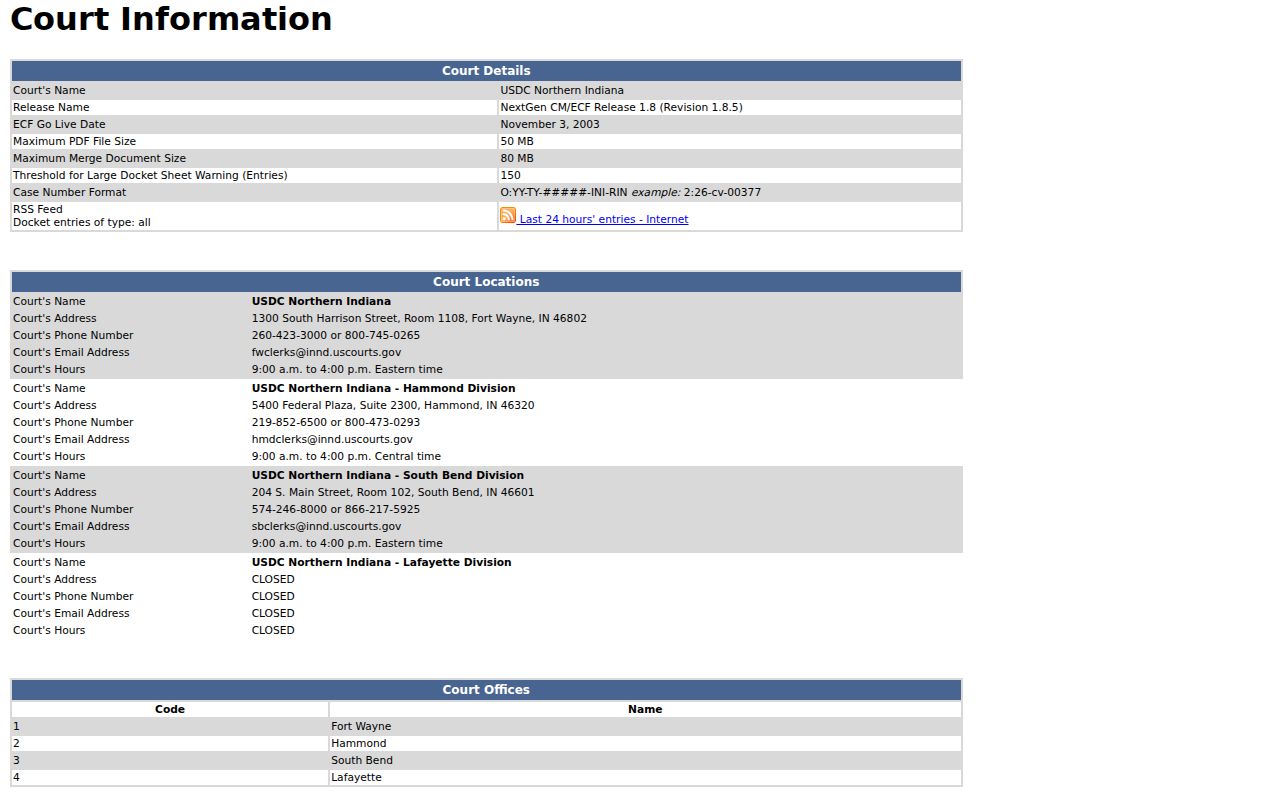
None of those federal fields match Miami County's own identifiers, 52C01, 52D01, and 52D02. A federal Clerk or PACER search is the only way in.
Access Rules for Criminal Dockets
Indiana MyCase displays nonconfidential Odyssey information, yet it is not the official court record. Indiana Access Rule 5 keeps whole categories out of public view. Juvenile, mental-health, protection-order, and sealed records fall under it. So does anything shielded by statute, order, or privilege. So a public case header never opens every document behind it.
Key access rule: Indiana Access Rule 5 governs court records excluded from public access and the state's redaction framework.
If an item is missing, ask the Clerk whether the issue is case-level sealing, document restriction, redaction, exclusion, conversion, or a portal problem. Do not ask staff to disclose protected content.
A docket search can come back empty for several reasons. The number may sit in the wrong field. The county or category could be off. The filing may fall outside your date range. A transfer may have shifted how the record is indexed. Access may simply be limited. Retry the exact number without guessing. Then give the Clerk the court, the rough year, the party spelling, and what you need. The Clerk can explain the route in. The Clerk cannot open protected content or advise you on the case itself.
Indiana's Access to Public Records Act, IC 5-14-3, does not make the Clerk custodian of every agency record either. BMV, prosecutor, law-enforcement, federal, and bankruptcy records each answer to their own custodians and rules. Miami County Drug Court, diversion, probation, and similar problem-solving channels may hold supervision records apart from the public CCS. Read a program entry as just that: it is not proof of eligibility, completion, or any term imposed.